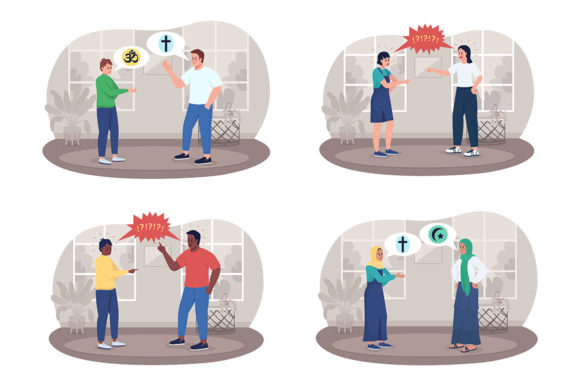
Understanding Family Tensions: The Conflict with Parents Illustrations Set
Creating content that resonates with a real human experience requires more than just good copy; it demands visuals that tell the truth. In the world of design assets, finding imagery that accurately depicts the complexity of family dynamics—specifically the friction between generations—can be surprisingly difficult. Most stock libraries offer generic smiling families or overly dramatic staged arguments. However, the Conflict with Parents Illustrations Set strikes a delicate balance between stylized art and emotional reality. This collection provides a distinct visual language for a topic that is rarely easy to discuss but incredibly common to experience.
Anatomy of the Scene: Visual Style and Character Design
When you look at the Conflict with Parents Illustrations Set, the first thing you notice is the "flat design" aesthetic. This isn't the glossy, 3D-style illustration of the early 2000s. Instead, it utilizes clean lines, solid color fills, and a lack of complex gradients. This approach is intentional. Flat characters are universally readable; they lack the specific details that might alienate a viewer, allowing the audience to project their own experiences onto the figures. The color palette is described as "colourful," which is a strategic choice for such a heavy topic. By using vibrant, saturated hues, the illustrations prevent the content from feeling depressing. It maintains a modern typography and illustration vibe that feels accessible rather than clinical.
The character design focuses on body language. You have the upset teenager—likely slumped shoulders, a turned-away head, or animated hand gestures—and the parents, who might appear stern, confused, or pleading. This is modern typography in visual form: efficient, direct, and stripped of unnecessary noise. For a designer, this means you don't have to fight with the image to make it fit a layout. The 2D vector nature of the files ensures that whether you are scaling this up for a banner or down for a mobile app icon, the lines remain crisp. The "cartoon background" element provides context without competing for attention, ensuring the foreground drama remains the focal point.
Strategic Applications: Where These Vectors Belong
The versatility of the Conflict with Parents Illustrations Set extends far beyond simple blog post headers. For entrepreneurs and small business owners in the mental health, education, or parenting sectors, these assets are foundational. A family therapist could use these vectors for their web design to instantly communicate their specialty in adolescent counseling. The imagery breaks the ice before a word is read, signaling to the visitor: "We understand your struggle."
For marketers and publishers, the utility lies in storytelling. Consider a magazine article on "The Generation Gap" or a social media campaign promoting a new parenting book. Using these flat characters allows you to create a narrative arc in a single image. Because the file formats include EPS, SVG, AI, PNG, and JPEG, you have total control. You can edit the vector paths in Adobe Illustrator to change the color of a shirt to match your brand identity or reposition the parents to fit a horizontal banner layout.
Here are specific scenarios where this set shines:
- Editorial Design: Using the illustrations as spot art within a magazine layout to break up long columns of text about teenage psychology.
- Social Media Graphics: Creating carousel posts for Instagram that depict a progression of conflict to resolution, driving engagement.
- Packaging Design: For products aimed at mediation or family games, the characters can be integrated into the box art to set a lighthearted yet relevant tone.
- Presentations: Educators and content creators can use these slides to visualize data regarding family trends or behavioral studies.
Integration with Typography and Brand Voice
While the Conflict with Parents Illustrations Set provides the visual anchor, the success of your project depends on how well these images integrate with your typeface choices. Because the illustrations are "cartoonish" and colorful, they pair exceptionally well with friendly, rounded sans serif fonts. Think of typefaces that have a humanist quality—fonts that feel warm rather than industrial. A heavy, gothic serif font might feel too formal and clash with the playful nature of the vector art.
However, if your goal is to create a more serious editorial piece, you might pair the illustrations with a clean, high-contrast serif font to create a juxtaposition between the serious topic and the approachable art style. This is a classic font pairing strategy: mixing a serious voice with a lighthearted visual. For logo design or specific headers, a handwritten font or script font could be used to emulate the personal, diary-like feeling of a teenager's perspective. The key is to let the illustrations handle the emotion while the typography handles the information.
Technical Flexibility and File Utility
The practical value of a premium font or illustration set often comes down to the technical delivery. The availability of SVG and EPS formats is a massive advantage for professionals. Unlike a static JPEG, these vector formats allow for infinite scalability. If you are designing a mural for a youth center or a tiny icon for a mobile UI, the integrity of the image holds up. This flexibility is crucial for maintaining a consistent visual identity across all platforms.
Furthermore, the isolated nature of the characters means they can be extracted from the background. You can place the "upset teenager" onto a solid color background that matches your brand identity palette, or layer them over a photograph for a mixed-media effect. This adaptability makes the Conflict with Parents Illustrations Set a robust component of any designer's toolkit. It is not just a single image; it is a modular system of design assets.
Visual Hierarchy and Audience Engagement
Using strong, emotive imagery directly influences how your audience engages with your content. In the hierarchy of a page, the eye is naturally drawn to human faces and figures. By placing the Conflict with Parents Illustrations Set strategically, you can guide the viewer's eye down the page. For bloggers and content creators, this means lower bounce rates and higher time-on-page. The imagery validates the user's search intent immediately. If someone is searching for advice on dealing with strict parents, seeing a visual representation of that tension creates an immediate psychological bond.
For crafters and hobbyists, the appeal is different but equally valid. These vectors can be used for personal projects like scrapbooking, custom greeting cards for family therapy graduates, or even printed on merchandise like tote bags or t-shirts that feature relatable quotes about parenting. The "isolated" nature of the illustrations makes them perfect for cutting machines (like Cricut or Silhouette), allowing for precise die-cuts.
Maintaining Professionalism in Sensitive Topics
One of the biggest challenges in marketing and design regarding family conflict is avoiding offense. Photography can sometimes be too raw or specific—actors might look too angry, or the setting might look too messy. The Conflict with Parents Illustrations Set avoids this by using the abstraction of 2D vector art. It depicts the conflict without showing aggression or abuse. It focuses on the "argument" and the "upset" mood, which is a safe, commercial-friendly way to represent struggle. This ensures that your creative font and image combinations remain professional and suitable for a wide audience, from school counselors to parenting magazines.
Ultimately, this collection is about empathy. It provides a visual shorthand for a complex emotional state. Whether you are building a website for a family practice or creating a presentation on adolescent development, these design assets offer a polished, professional, and deeply relatable way to communicate. By combining these visuals with thoughtful modern typography, you can create projects that not only look good but feel authentic to the human experience of growing up.